Customer Credit in a Shop: Keeping the Daftar Without Losing Track
Selling on credit to regulars: the rules to set first, debts kept in dollars and paid in either currency, partial payments, and following up politely.
5 min read
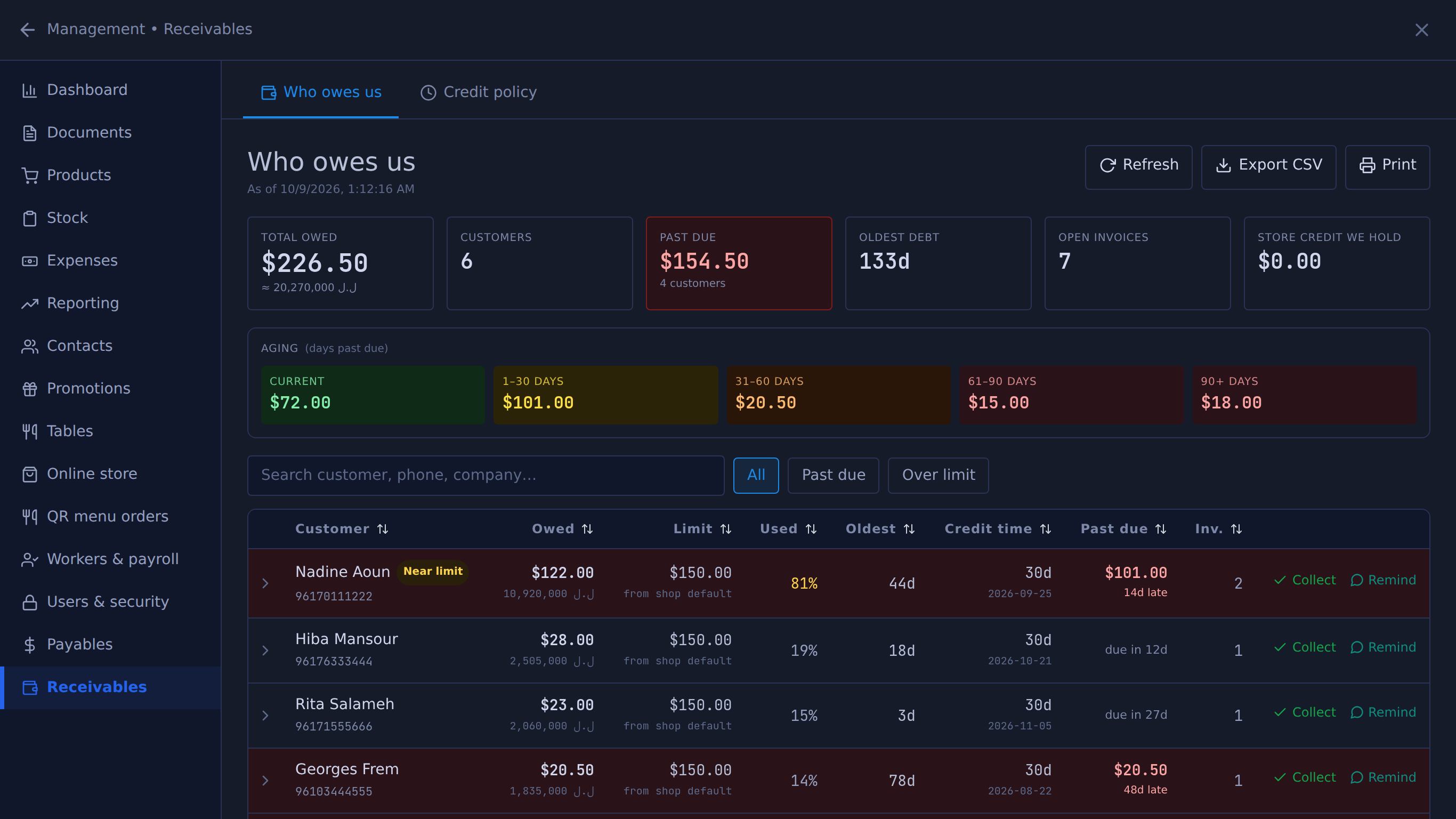
Many neighbourhood shops in Lebanon sell on credit to people they know. The daftar is how it has always been done: a name, what they took, what they owe, crossed out when they pay. It works while the list is short and the person writing in it is the person who remembers. It stops working when two people serve at the counter, when payments come in pieces, or when a page goes missing.
What a daftar has to answer
#Whatever you keep it in, a credit book has to answer five questions without relying on anyone's memory: who owes money, how much, since when, for what, and what they have paid back so far. If yours cannot answer the last two, every disagreement at the counter becomes your word against the customer's.
Set the rules before the first sale on account
#Decide four things and write them down. With the rules on paper, the awkward conversation is about the shop's rule, not your mood that day.
- A limit per customer: the most they can owe at once. A regular who has paid on time for years can have a higher one than someone new.
- A payment term: how long a debt can stay open before it counts as late, such as 30 days.
- Who may go over the limit: the owner, or one trusted person, and nobody else.
- What happens when someone is late: you ask before they take more, and you stop extending credit after a set point.
Dollars, lira and partial payments
#Keep each debt in dollars. A balance written in lira is worth less in dollars every time the lira falls, and nobody wants to argue about which day's rate applies. The customer can still pay in either currency: take the lira at the day's rate and note the dollar amount it settles.
People rarely pay a debt in one go. Apply each payment to the oldest debt first unless the customer asks otherwise, so old items do not linger. If someone pays more than they owe, the difference is a credit for their next visit, not a mistake to fix later.
Following up without losing the customer
#Sort what is owed by how late it is: not yet due, up to 30 days late, 31 to 60, 61 to 90, and more than 90. A customer a few days late needs nothing. One two months late needs a polite word before their next purchase. One three months late needs a decision.
A short WhatsApp message with the exact amount and a thank-you is easier on everyone than a reminder at the counter in front of other customers. And when a small leftover will never be paid, writing it off is cleaner than carrying it for a year.